
Skin Marker Uses Across Medical, Surgical, Tattoo & PMU Fields

Table of Contents
- How Is a Skin Marker Different from a Regular Marker?
- Sterile vs Non-Sterile Skin Markers
- Common Applications of Skin Markers
- Surgical Site Marking
- Medical Education and Training
- Dermatology and Cosmetic Procedures
- Radiology and Medical Imaging
- Tattoo and Permanent Makeup (PMU)
- Why Choose Chief Ling’s Surgical Skin Marker Pens?
- FAQs
Skin markers play an important role in improving accuracy, communication, and consistency during medical and cosmetic procedures. Without clear skin markings, the risk of errors increases. By marking the planned treatment area directly on the skin, practitioners can confidently perform the procedure at the intended location. At the same time, skin markings help patients and clients visualize the planned treatment before it begins. They also provide a clear visual reference when multiple treatment practitioners are involved, helping maintain consistency throughout the procedure.
How Is a Skin Marker Different from a Regular Marker?
Although skin markers may look similar to ordinary permanent markers, they are designed for entirely different purposes. Skin markers are specially designed for temporary marking on human skin, whereas general-purpose markers are intended for writing on paper, plastic, metal, and other non-skin surfaces.
One of the main differences is the ink formulation. Skin marker ink is commonly based on gentian violet and is designed for temporary skin marking. The ink is also evaluated through biocompatibility testing to help ensure it is suitable for contact with human skin. In contrast, general-purpose markers often contain solvent-or alcohol-based inks intended for industrial or office use. These formulations may cause skin irritation, produce strong odors, and are not designed for direct skin application.
Manufacturing standards also differ significantly. Skin markers are typically produced in cleanroom environments under medical device quality management systems to help maintain consistent product quality. General-purpose markers, however, are manufactured for non-medical applications and are not subject to the same production requirements.
Skin markers can generally be classified into two main types: sterile and non-sterile. The following section explains the differences between them.
Sterile vs Non-Sterile Skin Markers
Not all skin marking applications require the same level of infection control. To support different professional applications and workflows, skin markers are available in both sterile and non-sterile versions. Choosing the appropriate type depends on whether the marking will be performed in a sterile environment.
Sterile Skin Markers
Sterile skin markers are sterilized using methods such as gamma irradiation (Gamma) or ethylene oxide (EO) and are individually packaged to maintain sterility until use. They are intended for operating rooms and other sterile environments where additional skin markings may be required after a sterile field has been established. Using a sterile skin marker helps maintain the integrity of the sterile field while allowing healthcare professionals to continue marking the skin when needed.
Non-Sterile Skin Markers
Non-sterile skin markers are commonly used when sterility is not required. They are suitable for treatment planning, medical education and training, tattoo design, permanent makeup (PMU), and other applications performed outside a sterile environment. They are commonly used in outpatient clinics, medical education and training, tattoo studios, and permanent makeup (PMU) practices where sterile packaging is not required.
Common Applications of Skin Markers
Skin markers can be used in a wide range of clinical and non-clinical applications. Depending on the procedure, the markings may indicate surgical incision sites, imaging positions, treatment areas, or tattoo designs. The following are some of the most common applications of skin markers.
Surgical Site Marking
A surgical skin marking pen is primarily used before surgery to outline incision lines, identify the correct surgical site, and define the treatment area. These markings provide clear visual guidance throughout surgical planning and help reduce the risk of wrong-site surgery.
Because the skin is typically disinfected with solutions such as chlorhexidine or povidone-iodine before surgery, medical skin marker ink must remain highly visible and resistant to fading during skin preparation. To minimize the risk of cross-contamination, surgical skin marker pens are generally designed for single-use. To meet different clinical requirements, surgical marker pens are available in both sterile and non-sterile versions, each designed for use at different stages of patient preparation.
Preoperative Planning
Non-sterile skin markers are commonly used before a sterile field is established, such as in outpatient clinics, hospital wards, emergency departments, or during preoperative preparation. They are typically used for initial site identification, treatment planning, and surgical site marking before the patient enters the operating room.
Intraoperative Marking
Sterile skin markers are sterilized and individually packaged to maintain sterility until use. They are intended for operating rooms and other sterile environments where additional markings may be needed after a sterile field has been established. Using a sterile skin marker allows healthcare professionals to continue marking the surgical site without contaminating the sterile environment.
Medical Education and Training
Skin markers are widely used in medical education and hands-on training to illustrate anatomy and demonstrate medical procedures on the human body. Instructors may draw bones, muscles, joints, blood vessels, or injection sites directly on a volunteer or simulation model, helping students visualize anatomical structures and understand each step before practicing the technique.
Dermatology and Cosmetic Procedures
Skin markers are widely used to plan dermatology and cosmetic procedures before treatment begins. They help practitioners mark multiple treatment areas, ensuring that no area is missed during the procedure. For cosmetic treatments such as dermal fillers, permanent makeup, or facial contouring, skin markings also help map the treatment according to the client's facial features and bone structure, resulting in more balanced and consistent outcomes.
Radiology and Medical Imaging
Skin markers may be used before radiology and medical imaging to indicate examination areas, mark reference points such as joints or bones that can be felt through the skin, or provide visual guides for patient positioning. Surgical marker pens are designed for visual guidance only and do not appear on X-ray or CT images.
Clearly visible skin markings help healthcare professionals reproduce the same positioning across multiple imaging sessions, improving examination consistency.
Tattoo and Permanent Makeup (PMU)
Before tattooing or applying permanent makeup (PMU), artists use skin markers to sketch the design directly on the skin. These markings help define the shape, placement, and size of the design while allowing both the artist and client to check the overall appearance before any permanent pigment is applied.
For these applications, precision is especially important. The tattoo skin marker pen or PMU marker pen should produce fine, accurate lines that remain visible throughout the planning process while allowing adjustments to be made before the final design is tattooed.
Why Choose Chief Ling’s Surgical Skin Marker Pens?
Choosing a surgical skin marker pen supplier involves more than selecting the right product. Consistent quality, regulatory compliance, and reliable manufacturing are equally important, especially for medical brands and distributors serving international markets.
Chief Ling manufactures surgical skin marker pens for customers worldwide. Our product line includes fine-tip and regular-tip models, with both sterile and non-sterile options to support a wide range of medical applications. We also provide OEM surgical marker manufacturing services for brands seeking reliable, high-quality production.
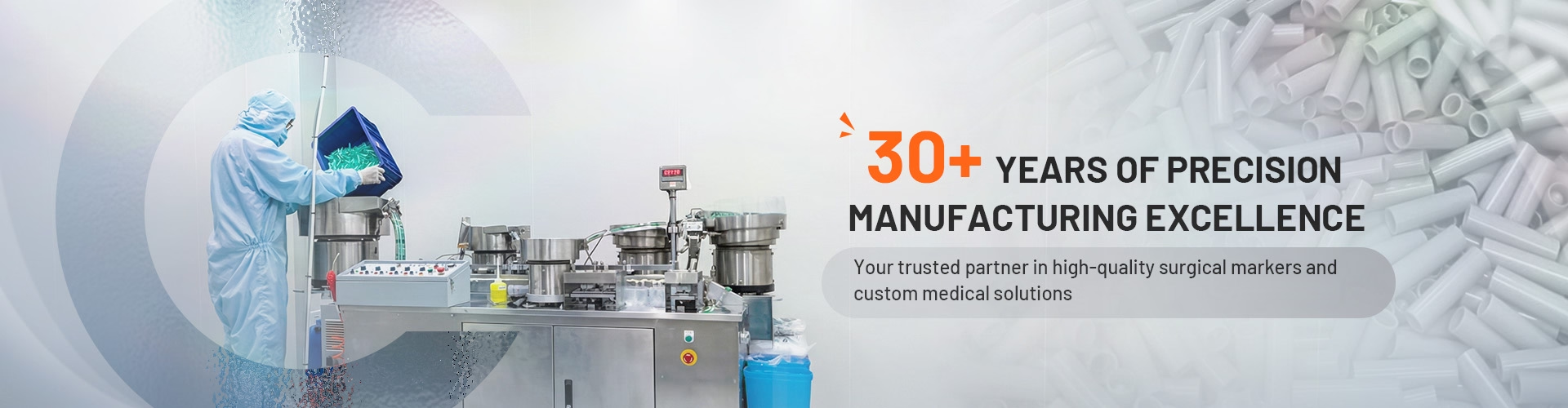
Quality is built into every stage of our manufacturing process. Our facilities operate under an ISO 13485-certified quality management system, and our surgical skin markers are manufactured in cleanroom environments to ensure consistent quality.
In addition to manufacturing, Chief Ling offers OEM and ODM services for customers developing their own medical brands. Whether you require product customization, packaging design, or a private label surgical marker solution, our experienced team works closely with you to develop products that meet your market requirements. Backed by stable production capacity and global export experience, we are committed to being a dependable long-term manufacturing partner.
Whether you're looking for an OEM partner or planning to launch your own private-label medical products, contact Chief Ling to learn more about our surgical skin marker solutions.
FAQs
Surgical skin markers can be purchased through medical supply distributors or directly from OEM manufacturers. Before purchasing, it is important to verify that the products comply with relevant quality standards and are suitable for the intended application.
Chief Ling offers both ready-to-ship surgical skin markers and factory-direct OEM and ODM manufacturing services. Our team works with medical brands, hospital groups, and international distributors to develop customized products, packaging, and branding solutions. By working directly with the manufacturer, customers also benefit from competitive pricing and reliable production support.
Whether you need in-stock products or OEM services, contact us to discuss your requirements.
The marking can typically be removed with an alcohol-based cleanser or a standard skin cleanser after the medical procedure is complete.
Choosing the right supplier for OEM private label surgical markers requires evaluating more than the product itself. When comparing manufacturers, ask whether the supplier:
- Operates under an ISO 13485-certified quality management system
- Manufactures products in cleanroom environments
- Can support stable, high-volume production
- Offers OEM and ODM customization services
- Uses automated manufacturing to ensure consistent product quality
- Has experience exporting to international markets
- Can provide testing reports and quality documentation
Evaluating these capabilities can help you identify a manufacturing partner that delivers consistent product quality, regulatory compliance, and reliable long-term supply.
Related Articles
- Surgical Skin Markers: Ensuring Precision and Safety in Modern Surgery - A closer look at surgical skin markers and how to choose one.
- Reusing PMU Skin Markers: Safe or Risky Practice? - Hygiene considerations for skin markers in permanent makeup.

